
Forklift Operator Training in Bloemfontein: Your 5-Day Path to a New Career
If you’re sitting in Bloemfontein wondering how to break into the logistics or warehousing industry without spending years studying, forklift operator training might be exactly what you need. It’s quick, it’s practical, and it opens doors to real jobs across the Free State.
Let me walk you through what this training actually involves, what you’ll earn, and how you can get started right here in the City of Roses.
How long does forklift training actually take?
Here’s the good news: forklift operator training takes only 5 days. Yes, five working days from start to finish. You’ll cover theory, hands-on practice, safety protocols, and your final assessment all within one week.
This makes it one of the most accessible skills programmes available in Bloemfontein, especially if you’re currently unemployed or working and can’t afford to spend months in a classroom. You’re in and out with a nationally recognised certificate in hand.
What are the different forklift licence codes in South Africa?
South Africa uses what’s called the F-Code system to classify forklift operators based on the weight capacity they’re trained to handle. Understanding these codes is important because they determine where you can work and how much you can earn.
Here’s how it breaks down:
- F1 – Counterbalanced Lift Truck (up to 3,000 kg) – This is your entry-level code, suited for light warehouse work like moving pallets in retail distribution centres or small manufacturing plants.
- F2 – Counterbalanced Lift Truck (up to 7,000 kg) – A step up. You’ll handle heavier yard and logistics work, common in medium-sized factories and freight depots around Bloemfontein and beyond.
- F3 – Counterbalanced Lift Truck (up to 15,000 kg) – This is for industrial heavy-load handling. Think large-scale operations like agricultural storage facilities or construction supply yards.
- F4 – Counterbalanced Lift Truck (above 15,000 kg) – Specialised heavy-duty operations. These machines are used in ports, major industrial plants, and large-scale mining support operations.
Most learners start with F1 or F2, depending on where they want to work. You can always upgrade later as you gain experience.
How long is a forklift licence valid?
Your forklift licence is valid for two years. After that, you’ll need to renew it. Renewal usually involves a refresher course to ensure you’re still operating safely and in line with current regulations. Don’t let it lapse—employers check this.
What does the forklift training course cover?
Here’s a breakdown of what you’ll actually learn during your 5-day training:
| Component | What You’ll Learn |
|---|---|
| Theory | Load capacity, weight distribution, forklift parts and functions, workplace safety regulations, hazard identification |
| Practical Training | Operating controls, lifting and lowering loads, stacking and unstacking pallets, reversing and manoeuvring in tight spaces |
| Safety Procedures | Pre-operation inspections, emergency stops, pedestrian awareness, safe refuelling or recharging, incident reporting |
| Final Evaluation | Written theory test and practical assessment observed by an accredited assessor |
The training is designed so that even if you’ve never touched a forklift before, you’ll be competent and confident by the end of the week.
Where do forklift operators work in the Free State?
The Free State economy might not have the industrial density of Gauteng, but there’s steady demand for forklift operators in several key sectors:
- Agricultural supply chains – The Free State is South Africa’s breadbasket. Grain silos, feed mills, and agricultural co-ops all need forklift operators to move stock.
- Retail and wholesale distribution – Stores like Makro, Game, and Builders Warehouse have distribution centres that rely on forklifts daily.
- Manufacturing plants – From food processing to furniture production, forklifts keep production lines moving.
- Construction suppliers – Timber yards, steel suppliers, and hardware depots in and around Bloemfontein need operators to handle heavy materials.
- Freight and logistics hubs – Couriers, trucking companies, and third-party logistics providers are always looking for skilled operators.
Even if you start in Bloemfontein, your qualification is recognised nationally, so you’re not geographically locked in.
What can I realistically earn as a forklift operator?
Salaries vary based on experience, the F-code you hold, and the industry you work in. Here’s a realistic Free State overview:
- Entry-level (F1, no experience): R6,000 – R8,000 per month. You’re learning the ropes, working under supervision, usually in retail or light warehousing.
- Experienced operator (F2, 1–3 years): R9,000 – R12,000 per month. You’re trusted to work independently, handle more complex loads, and possibly train new hires.
- Skilled operator (F3, 3+ years): R12,000 – R16,000 per month. You’re in industrial settings, managing heavy machinery, and your skills are in demand.
- Specialised operator (F4, highly experienced): R16,000+ per month. These roles are fewer but pay better, especially in mining support or large-scale manufacturing.
Higher F-codes and more experience genuinely do lead to better pay. It’s not just theory.
Is Real Skills Training Institute accredited?
Yes. Real Skills Training Institute is accredited by TETA, CETA, HWSETA, and the QCTO. This means your training meets national standards and your certificate will be recognised by employers across South Africa.
Don’t settle for fly-by-night operators offering cheap courses with certificates that mean nothing. Accreditation matters.
Are Real Skills certificates recognised?
Yes. Certificates issued by Real Skills Training Institute are nationally recognised in South Africa. Employers, recruitment agencies, and labour brokers all accept them. You won’t have any issues when applying for jobs.
Frequently Asked Questions
1. Do I need any previous experience to enrol?
No. The course is designed for complete beginners.
2. What documents do I need to bring?
A certified copy of your ID, a recent passport photo, and proof of residence.
3. Is there an age limit?
You must be at least 18 years old.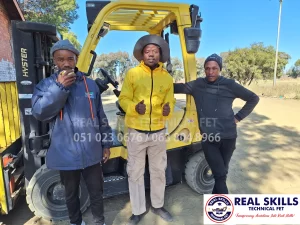
4. Can I get financial assistance?
Some learners qualify for SETA funding or learnerships. Contact the institute to discuss options.
5. What happens if I fail the assessment?
You’ll be given additional training and a chance to rewrite or redo the practical.
6. Is the training in English or Afrikaans?
Training is available in both languages, depending on the group. Let them know your preference.
7. Will I get a job after completing the course?
The institute doesn’t guarantee employment, but many employers in Bloemfontein actively recruit certified operators.
8. Can I upgrade from F1 to F2 later?
Yes. You can take additional training for higher codes as your career progresses.
9. Is the training done on real forklifts?
Absolutely. You’ll train on actual equipment in realistic working conditions.
10. How soon can I start working after I qualify?
Immediately, once you have your certificate in hand.
11. Is Real Skills Training Institute accredited?
Yes. Accredited by TETA, CETA, HWSETA, and the QCTO.
12. Are Real Skills certificates recognised?
Yes. Certificates are nationally recognised in South Africa.
Ready to get started?
If you’re serious about changing your career or landing your first real job, forklift operator training is a smart, fast, and affordable option. Five days from now, you could be certified and ready to work.
Real Skills Training Institute – Bloemfontein
Street Address: 101 St Andrew Street, Bloemfontein, 9300
2nd Floor, St Ives Building
Website: www.realskillztraininginstitute.co.za
Email: info@realskillztraininginstitute.co.za
Phone: 051 023 0676 / 063 804 8966 / 067 052 3590


